
Tree work for Wilmington & the Cape Fear coast
Tree Removal in Wilmington, NC
Safe takedowns of storm-damaged, dead and oversized trees, planned around hurricanes, sandy soil and city tree rules.
- On-site quotes at no charge in Wilmington and nearby towns
- Prices put in writing before the crew arrives
- Cleanup terms written into the estimate
Removing Trees in a Hurricane Town
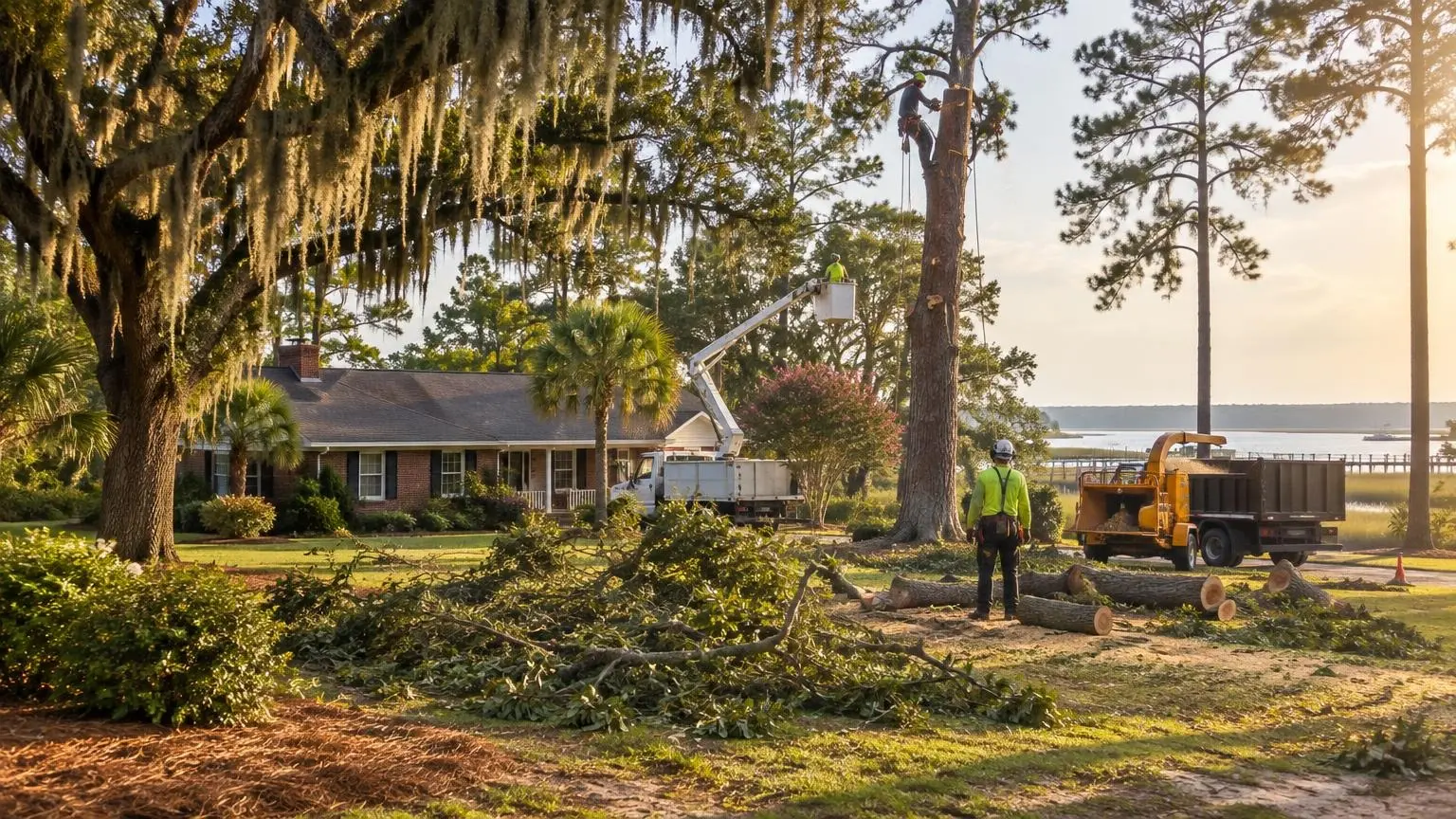
Tree removal in Wilmington is shaped by the weather off the Atlantic. The city sits between the Cape Fear River and the ocean, gets a little over 60 inches of rain in an average year, and sees a hurricane or tropical storm roughly once every seven years, most often between August and early October. When Hurricane Florence came ashore just south of Wrightsville Beach on September 14, 2018, Wilmington International Airport recorded a 105 mph gust, more than 90 percent of New Hanover County lost power, and flooding cut the city off from the mainland. Trees and power lines came down across the county, and a tree falling on a Wilmington home killed a mother and her baby. Most of the removals we quote come back to that history: which trees are likely to fail in the next storm, which ones were weakened in the last one, and how to take them down without hurting anything nearby.
Which trees cause the trouble
Not every big tree is a risk, and some of the largest trees in town are the toughest. NC State Extension lists live oak, southern magnolia and bald cypress among the most wind-resistant large trees, based on studies of hurricane survivors along the Gulf and Florida coasts. The same guidance names pines, laurel oak, water oak, Leyland cypress, Bradford pear, red maple and pecan as weak-wooded trees that are prone to wind damage near buildings. That matches what we see. Laurel oaks make up about 14 percent of the city's inventoried trees, and they are often the problem: in July 2026 the city removed laurel oaks on South Live Oak Parkway that looked healthy from the outside but had decay in their main limbs and cavities as deep as two feet. When we look at a big laurel or water oak, we look hard at the base, old pruning wounds and the unions where large limbs join the trunk.
Pines after a storm
Tall loblolly and longleaf pines are everywhere in Wilmington's neighborhoods. A pine that loses its top, gets struck by lightning, or sits in flooded ground for days is stressed, and stressed pines draw bark beetles. NC State Extension describes the signs: needles fading from green to yellow to red, popcorn-like lumps of sap called pitch tubes on the bark, and winding galleries under loose bark. A red-topped pine near a house is usually a removal, and it is easier and cheaper to take down while the wood is still sound than after it has dried and gone brittle.
Wilmington's tree rules
The City of Wilmington regulates tree removal more than many North Carolina cities. A city Tree Removal Permit is needed for any tree in the public right-of-way, any tree four inches or more in diameter on a residential lot larger than one acre or a non-residential lot, trees in conservation setbacks and buffers, and any tree on a lot in a local historic district, which also needs a Certificate of Appropriateness. Removing a specimen tree, which covers large old native trees such as live oaks and cypress, requires Board of Adjustment approval. Cutting without a required permit carries a penalty of $150 per inch of trunk diameter or $1,200 per tree, whichever is greater. We check where your lot falls before quoting, so a removal doesn't become a fine.
Getting the wood out
City crews collect yard waste on trash day, but limbs have to be four feet long or less and no more than six inches thick, the pile can't exceed about seven cubic yards, and stumps, root balls and palm trunks are not collected at all. The city also notes that yard waste created by commercial contractors may not be picked up. So when you hire tree removal, ask what happens to the wood. Our quotes say whether logs are hauled away, cut and stacked for firewood, or left where you want them.
Why Homeowners Call Tree Removal Wilmington
Permits checked first
We tell you on the visit if a tree is in the city right-of-way, a historic district or another case that needs a Wilmington Tree Removal Permit, before you pay for anything.
A plan for every tree
The quote says how each tree comes down, in pieces with ropes, felled into open space, or with a crane, and what we are protecting underneath.
Haul-away priced up front
Because city crews won't take stumps or contractor-generated debris, the quote states plainly where the logs, brush and chips go.
Storm work by danger
After a hurricane or nor'easter, trees on homes, blocked doors and fallen trunks across driveways come before cleanup of yards and woods.
Communities on Our Route
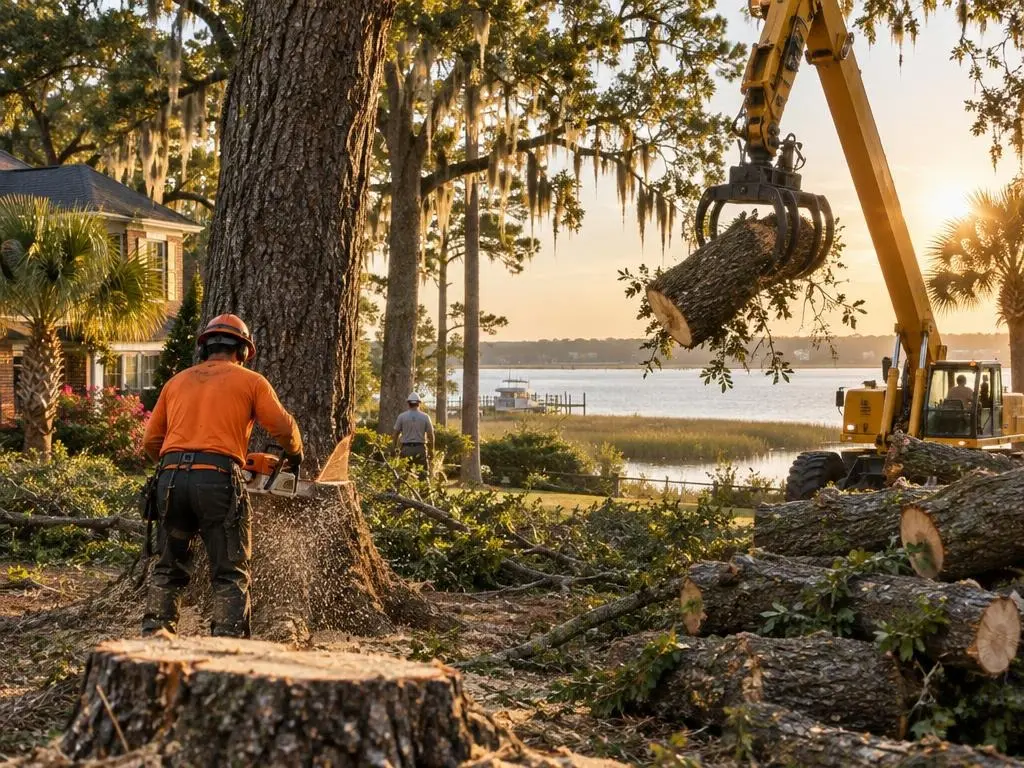
We work across Wilmington and New Hanover County: the downtown historic district and Carolina Heights, Forest Hills, Pine Valley, Ogden, Porters Neck, Masonboro, Monkey Junction, Myrtle Grove and Castle Hayne, plus Leland and the Brunswick County side of the river, and the beach towns of Wrightsville Beach, Carolina Beach and Kure Beach. The work changes from one to the next. Downtown lots are narrow, often in the historic district, with old live oaks and street trees close to houses. Older suburbs like Forest Hills and Pine Valley have large, decades-old oaks, and the fast-growing laurel and water oaks among them deserve a close look for decay. Newer subdivisions to the north and south were cut out of pine woods, so tall pines stand over newer roofs, and many have HOA rules to check. Near the sounds and the beaches, salt wind, sandy soil and tight access to raised homes shape how a tree comes down. The beach towns and the county each set their own tree rules, separate from the city's.
- Tree Removal in Wilmington, NC
- Tree Removal in Wrightsville Beach, NC
- Tree Removal in Carolina Beach, NC
- Tree Removal in Kure Beach, NC
- Tree Removal in Ogden, NC
- Tree Removal in Murraysville, NC
- Tree Removal in Myrtle Grove, NC
- Tree Removal in Kings Grant, NC
- Tree Removal in Skippers Corner, NC
- Tree Removal in Silver Lake, NC
- Tree Removal in Castle Hayne, NC
- Tree Removal in Porters Neck, NC
- Tree Removal in Bayshore, NC
- Tree Removal in Wrightsboro, NC
- Tree Removal in Sea Breeze, NC
- Tree Removal in Leland, NC
- Tree Removal in Belville, NC
- Tree Removal in Navassa, NC
- Tree Removal in Southport, NC
- Tree Removal in Boiling Spring Lakes, NC
- Tree Removal in St. James, NC
- Tree Removal in Hampstead, NC
- Tree Removal in Rocky Point, NC
- Tree Removal in Burgaw, NC
- Tree Removal in Surf City, NC
Tree Removal and Related Services
Six kinds of work make up nearly every job we quote around Wilmington, from a single dead pine to a yard full of storm debris.
Tree Removal
Full takedown of trees you no longer want or no longer trust, with the stump and wood handled the way you choose.
Learn more →Emergency Storm Tree Removal
Trees on roofs, cars and driveways after hurricanes, tropical storms and summer thunderstorms, handled in order of danger.
Learn more →Dead & Hazard Tree Removal
Removal of dead pines, rotting oaks and cracked or leaning trees before they fail on their own.
Learn more →Crane-Assisted Tree Removal
Lifting large or dangerous trees out in sections when there's no safe place to drop them and climbing isn't safe.
Learn more →Tree Trimming & Pruning
Clearing roofs, thinning crowns before hurricane season and removing dead wood, done to ANSI A300 standards.
Learn more →Stump Grinding
Grinding stumps below ground level so the spot can be mowed, planted or built on.
Learn more →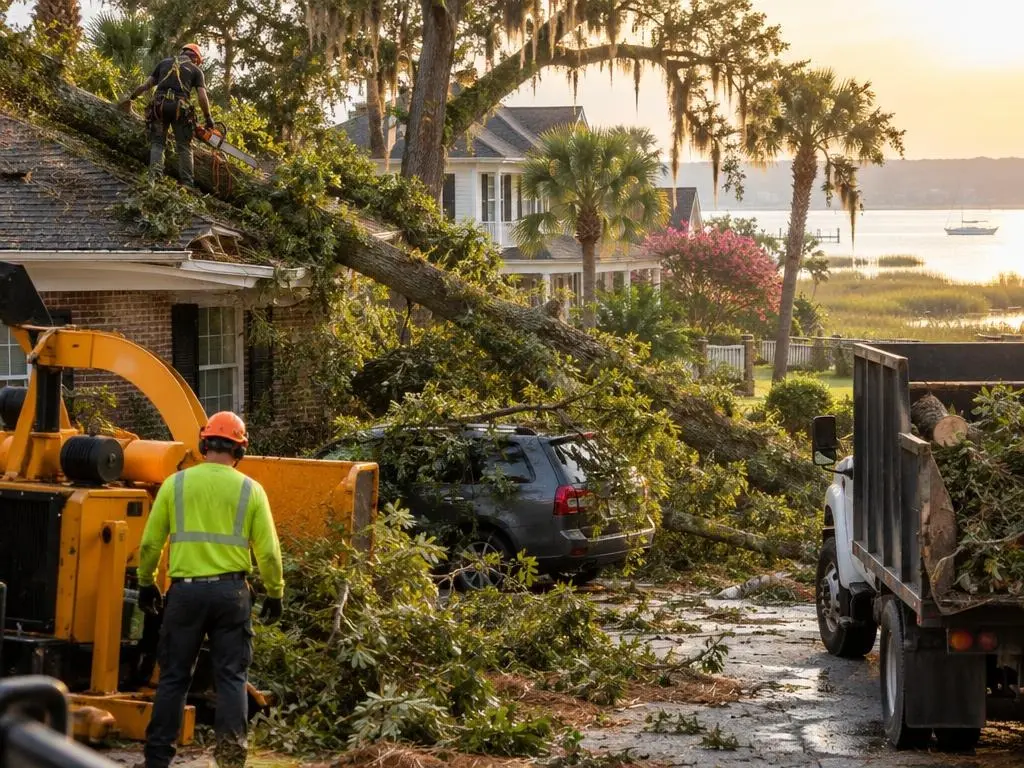
Common Questions
Do I need a permit to remove a tree in Wilmington?
It depends on where the tree is. The city requires a Tree Removal Permit for any tree in the public right-of-way, any tree 4 inches or more in diameter on residential lots over one acre or non-residential lots, trees in conservation setbacks or buffers, and any tree in a local historic district. Specimen trees need Board of Adjustment approval. If you're unsure, we'll look at your lot on the estimate visit, and the city's zoning staff can be reached at 910-254-0900.
How much does tree removal cost in Wilmington?
HomeBlue's Wilmington cost guide (2025) puts most removals between $400 and $1,800, with a typical job around $1,100 and a 40-foot tree around $450 to $860. Trees over roofs, near lines, or dead and brittle cost more because they have to be taken down in small pieces. Your written estimate is the price.
Who handles a tree touching a power line?
Stay at least 10 feet away and call Duke Energy, not a tree company, if a tree or limb is on a power line. For the service line running to your house, Duke Energy says the property owner is responsible for keeping it clear, and it will disconnect that line at no cost before tree work if you or your contractor contact them first. We coordinate that before working near your service drop.
The city tree in front of my house looks dangerous. Can you remove it?
Not without the city's say. Trees in the public right-of-way belong to the City of Wilmington, which maintains more than 30,000 street trees, and removing one requires a permit. If a damaged city tree is an immediate danger, the city says to call 911; otherwise, report it to the city.
Should I remove my pines before hurricane season?
Healthy, well-rooted pines don't need to come down just because a storm might come. Pines that are dead, red-topped, leaning toward the house, cracked, or growing in a spot where roots can't spread are a different story. A visit before August lets you deal with the risky ones calmly instead of after a storm, when every crew in town is booked.
Is there a tree removal company near me that will also grind the stump?
Yes, we grind stumps as part of a removal or as a separate job, anywhere in Wilmington and the nearby towns. Stumps aren't collected by city yard-waste crews, so grinding is the usual way to get rid of one. The quote shows the stump as its own line, so you can leave it if you prefer.
Will homeowners insurance pay for removing a fallen tree?
Policies differ, so check yours, but insurers commonly cover removal when a fallen tree damages a covered structure such as the house or a garage, and often pay less or nothing for a tree that falls in an open yard without hitting anything. Take photos before anything is moved. We provide a written, itemized invoice you can send to your adjuster.
Talk to Us About Your Trees
Free on-site estimates across Wilmington and New Hanover County. Call (910) 807-4337 or send the form with a few photos.